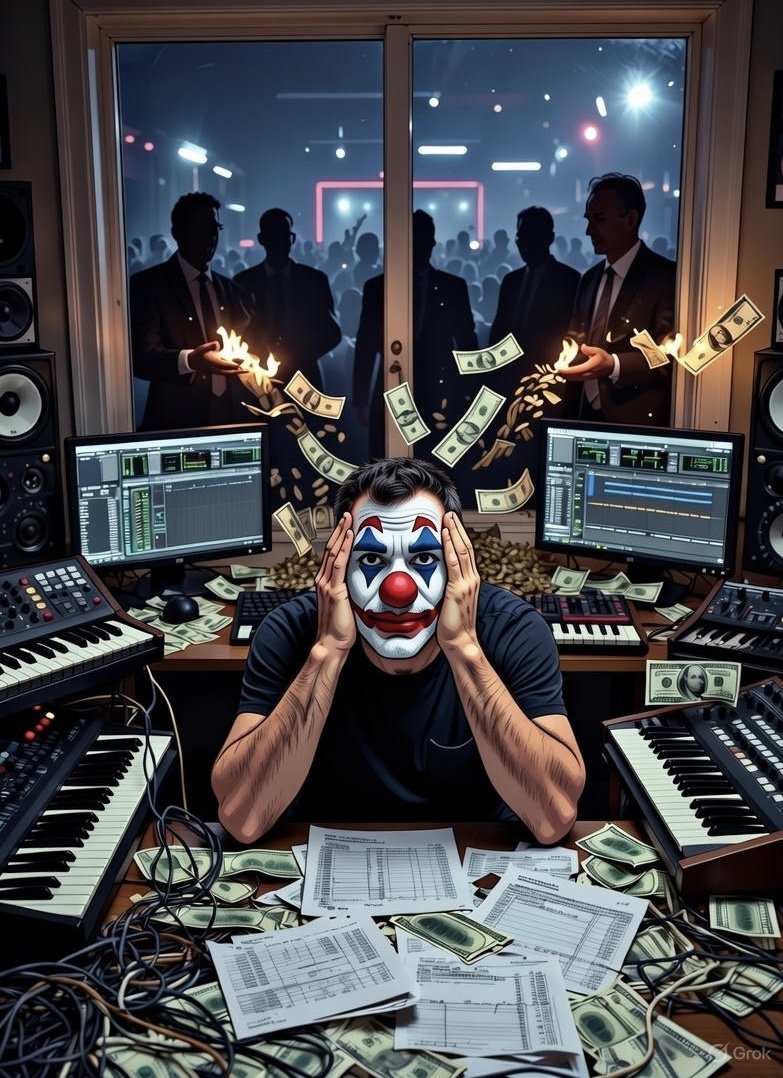
This Party's Dead
I’ve spent over twenty years behind the decks. As a classically trained musician with degrees in various disciplines and an economist’s eye for the grim math of late-night capitalism, I can tell you with absolute certainty: clubland is fucked. Everyone feels it. The punters sense it in their bones, the bartenders see it in the till and even the promoters whisper it after the last VIP has been poured into an Uber. Yet the agency game rolls on - smiles, back-slaps, “next level” Instagram stories—because admitting the patient is dying would kill the golden goose.
Let’s start with the music itself, because that’s where the soul used to live. Classic techno - Derrick May, Juan Atkins, the Belleville Three - was never about the three-minute banger. It was extended repetition, subtle timbre shifts, long unfolding phrases that worked like Steve Reich on hallucinogens or tribal drumming that could (and would) last all night. The point was expression and entrainment: your brainwaves syncing to the 4/4 pulse until time stretched, ego dissolved, and you entered that elusive dissociative flow where the dancefloor becomes one breathing organism (Aparicio-Terrés et al., 2025). Breakdowns and drops were not cheap tricks. They were cathartic releases after genuine harmonic or rhythmic tension - the same dramatic arc one finds in a Beethoven sonata or West African call-and-response. Dopamine and endorphins timed perfectly to the rise and fall—pure embodied pleasure (Solberg, 2014).
Today? The relentless shortening of tracks - now averaging well under five minutes (a far cry from the six-to-eight-minute odysseys of classic techno) - and the near-total flattening of dynamics aren't mere production fads. They're symptoms of a deeper impatience baked into the punters themselves. The generation raised on infinite scrolls and fifteen-second dopamine hits simply won't tolerate the slow-burn hypnosis that once defined the floor. Those patient builds, the gradual layering of percussion until the tension becomes almost unbearable, the cathartic release that felt earned after ten or fifteen minutes of entrained repetition. Instead, crowds demand insta-gratification: hooks in the first thirty seconds for the algorithm payout, instant drops for the phone-filmed climax, quick cuts to the next viral moment because lingering risks boredom or, worse, introspection. Hesmondhalgh (2022) said it best: we’ve traded sonic landscapes for pop singles with 130 BPM makeup on.
The hypnotic continuum is, sadly, gone. DJs used to sculpt journeys - stretching motifs, riding EQs, letting tension build for ten, fifteen, twenty minutes. Today we’re playlist-scrolling in real life: drop, cheer, next, repeat. The shaman has been replaced by the human jukebox. Once brooding sonic architects who spent years honing craft in dimly lit bedrooms and after-hours basements, DJs have devolved into cringe-worthy, Instagram-optimised aerobic jesters: grinning, sweat-drenched performers who treat the booth like a CrossFit stage, fist-pumping their way through pre-meditated “drops” while the actual music takes a distant second place to the perfect 15-second reel. The turntable mystic of yesterday, lost in private communion with vinyl grooves and subtle EQ curves, has been replaced by a new species: the content-first entertainer, less interested in musical narrative than in manufacturing viral facial expressions and cultivating theatricality for an audience that’s already scrolling away before the next track even begins. The result is music stripped of breath, of ebb and flow, reduced to compressed adrenaline shots that mirror our collective ADHD rather than transcend it - leaving the dancefloor energised but never truly transported, the aforementioned organism breathing in shallow gasps instead of one long, shared exhale.
Which brings us to the clubs themselves - the temples of engineered neurological discomfort designed, above all, to make you drink. It all started in the Prohibition-era speakeasies, where furtive dim lights and whispered toasts masked the era’s underground thirst, and was perfected in the post-war nightclub boom, when venues weaponized atmosphere against the wallet. Dim lights, as a Georgia State University study found, slash inhibitions and boost alcohol spending by 39 percent, turning hesitant sippers into high-rolling marks. Chest-rattling bass doesn’t just rattle your ribcage - it hijacks your intake, with a French field experiment showing patrons guzzling 30 percent more booze in half the time under high-volume din (Guéguen et al., 2008). Fog that smells like tomorrow’s regret, crowds packed tight enough to trigger every primate alarm bell in your limbic system, a sensory overload from aural and visual overstimulation - as documented in nightlife ethnographies - flood the system with cortisol and adrenaline, the brain screaming for relief. Enter alcohol, the perfect chemical fire blanket. It dampens the prefrontal cortex, turns anxiety into bravado and then empties wallets with surgical precision. Ethnographers have documented this for years - venues deliberately shift from “restaurant vibe” to “full sensory assault” precisely when bar sales need a kick, a tactic formalized in studies of “bar morphing” that tie these environmental flips to spikes in over-service and heavy drinking (Lee et al., 2017). The whole model is a neurological trap disguised as hedonism.
Except now the trap is springing open. Smartphones give punters an escape hatch - doomscrolling instead of surrendering to the unease. Gen Z is drinking 20-30 percent less than their elders, chasing wellness, run clubs, coffee raves and actual sleep (according to Gallup data, repeated in every industry survey). Post-COVID rave fatigue is real: a quarter of 18-25-year-olds have simply dialled back. Clubs panic and pivot—sober nights, wellness yoga-raves, app-based mood lighting—but, despite their sincerest efforts this all feels like watching a crack dealer launch a kombucha line. The economic formula that worked for decades is collapsing because the customer has changed.
A special mention here to the pseudo-club: the half-baked venues that miss the mark so completely they’re essentially glorified bars with delusions of grandeur, lacking any real engineering, professional sound system, coherent programming, or even viable business plan. These spots attract the bottom-feeders of the DJ world: desperate locals willing to spin for exposure, free drinks, or insultingly low pay rather than genuine gigs at proper establishments. The staff stumble through their undefined roles, yet somehow everyone clings desperately to the affiliation, posting blurry Stories and hashtagging their way toward phantom fame in a scene that barely notices them. Most flame out within a few years - funding dries up when dad stops writing checks, the novelty wears off, or some inevitable catastrophe (bad management, fights, license issues) finally pulls the plug. Industry data backs this grim cycle: around 60% of nightclubs fail within the first year, with the rest limping into a second before collapsing under poor planning, insufficient capital, or inability to stand out in an oversaturated market. These quasi-spaces aren’t engineered for hedonism or even basic nightlife They’re temporary vanity projects masquerading as cultural hubs, destined to join the long graveyard of short-lived dreams where ambition outran execution by miles.
So who are today’s customers? I interact with them almost every weekend. They want depth, safety, genuine connection, and they’re painfully aware that the dancefloor now doubles as content fodder. Half admit their phones “ruin” the night; the other half are already busy filming. They crave the old hypnotic surrender but arrive armed with scepticism, economic anxiety, and the muscle memory of two years locked indoors. Clubs pander: rainbow lighting, “inclusive” branding, low-alcohol menus - yet everything somehow feels hollow, the vibes forced. The unfortunate result is a vicious paradox. The more venues chase the new audience, the more inauthentic everything gets. Even the pure underground rooms that refuse to compromise are bleeding out - venue closures up 20 percent post-COVID - because purity doesn’t pay rent when the crowd size halves.
This all begs the question: who’s steering us into the rocks? The people running things, naturally. The DJs, promoters, bookers, and scene kingpins. It’s no secret that digital tools democratised everything: laptop + SoundCloud + TikTok and suddenly anyone can play. Except the economics didn’t follow suit. Bookings at SERIOUS rooms still go to the 1.6 percent with the biggest follower counts, the slickest networking, the richest parents, or the best back-scratching arrangements. Surveys show over half of emerging DJs now believe social-media metrics matter more than skill or artistic competence. Instagram fame with 50k bots EASILY trumps a decade of underground honing. Meanwhile, AI is already writing tracks, generating remixes, and soon enough will run adaptive sets via biometric feedback while the “artist” poses for selfies. The gatekeepers - affluent, algorithm-savvy, and allergic to self-reflection - have precisely zero incentive to fix any of this. And why would they? Their business model is spectacle economics, not sonic innovation.
In Berlin, the clubs that birthed techno are dying under UNESCO heritage plaques and skyrocketing rents. Ibiza counts €141 million in ticket revenue but has become a branded theme park. London has lost 36 percent of its clubs since 2020 while New York is the current champion of pay-to-play; the list goes on and everywhere, connections trump creativity.
The silence around all of this is, predictably deafening. Nobody wants to be the guy who says the emperor has no decks. Cancel culture, bruised fragile egos, fear of losing the next gig - pick your poison. Meanwhile the music flattens, the clubbers slowly drift away, and the venues pivot desperately between “authentic underground” branding and whatever is trending this month.
As a musician who still believes in the power of extended repetition to rewire human consciousness, I find the whole spectacle simultaneously tragic and darkly comic. We built a global culture on the promise of collective transcendence, then optimised it for quarterly returns, thirty-second attention spans, and perceived clout. The trance is gone, what’s left is content.
The fix won’t come from the top. The people currently running things are the least equipped - or motivated - to save it. Real change will have to bubble up from the floor: DJs who refuse the algorithm, promoters who book talent over followers, punters who vote with their feet and their wallets for rooms that still know how to let time disappear. Until then, clubland remains the perfect late-capitalist paradox: everyone can feel it’s fucked, yet the lights keep flashing, the drinks keep pouring, and the beat goes on, shorter and shallower every year.